July 31, 2026
Maximizing Wastewater Treatment Efficiency with High-Capacity VPSA Oxygen Systems
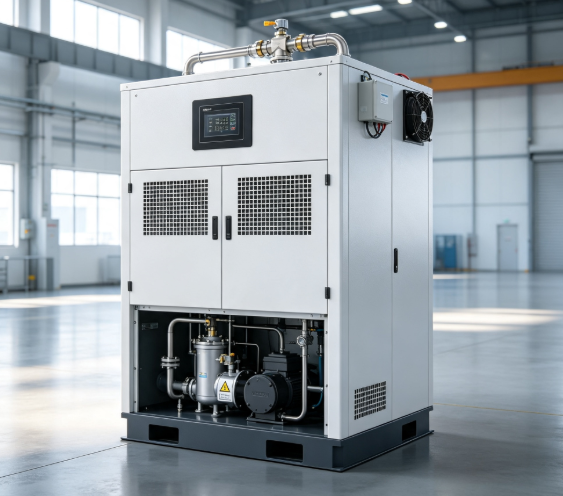
Table of Contents
The Oxygen Challenge in Modern Wastewater Treatment
What Is VPSA Technology?
Why VPSA Outperforms Traditional Oxygen Sources
How VPSA Works
Real-World Performance: The Rocky Mount Case
VPSA-O₃ Coupling: A Powerful Combination
Key Advantages for Wastewater Facilities
FAQ
Final Thoughts
The Oxygen Challenge in Modern Wastewater Treatment
Aerobic biological treatment is one of the most effective methods for removing organic pollutants from wastewater.But it requires one critical input: oxygen. Without adequate oxygen, bacteria cannot break down organic matter efficiently. Treatment efficiency drops. Effluent quality suffers. Compliance becomes a struggle.
Traditional oxygen sources—liquid oxygen (LOX) and cryogenic air separation plants—have long been the industry standard. But they come with significant drawbacks. Liquid oxygen must be purchased from external suppliers, transported to the site, and stored in cryogenic tanks. Prices fluctuate with market conditions. Supply disruptions can halt operations.
Cryogenic plants, while producing oxygen on-site, consume enormous amounts of electricity and offer little operational flexibility.They run at full capacity regardless of actual demand, often wasting half to two-thirds of the oxygen produced.
This is where VPSA technology changes the game.
What Is VPSA Technology?
VPSA stands for Vacuum Pressure Swing Adsorption. It is an advanced air separation technology that produces oxygen directly from ambient air.
The core principle is straightforward: molecular sieves adsorb nitrogen more readily than oxygen at elevated pressure.When compressed air passes through the adsorbent material, nitrogen is captured, allowing oxygen to pass through as the product stream.
What makes VPSA different from standard PSA is the regeneration step. Instead of simply depressurizing to release the adsorbed nitrogen, VPSA applies a vacuum to the adsorbent bed.This vacuum-assisted regeneration is more thorough and requires less energy than PSA systems operating at similar scales.
The result is a system that produces large volumes of oxygen—typically at 80–94% purity—with significantly lower energy consumption than cryogenic alternatives.
Why VPSA Outperforms Traditional Oxygen Sources
Vs. Liquid Oxygen (LOX)
Liquid oxygen requires constant replenishment from external suppliers. A 21 MGD wastewater treatment facility might consume 27 tons of oxygen per day.That translates to nearly 10,000 tons annually. At prevailing market prices, the annual procurement cost can exceed 27 million CNY (approximately $3.7 million USD).
Liquid oxygen prices are volatile. During peak demand periods, procurement becomes difficult and costly.VPSA eliminates this supply chain vulnerability by generating oxygen on-site, directly from the air.
Vs. Cryogenic Air Separation
Cryogenic plants are energy-intensive. They must run at full capacity continuously, with no ability to idle or turn down production.Even when oxygen demand drops, the plant keeps producing—and venting excess oxygen to the atmosphere.
A VPSA system, by contrast, offers automatic turndown from 100% to 0% flow capacity and idle features that dramatically reduce power consumption during low-demand periods.
How VPSA Works
A typical VPSA oxygen system consists of several key components:
Feed air blower — draws ambient air into the system
Adsorber vessels — contain the molecular sieve adsorbent
Vacuum pump — removes nitrogen during the regeneration cycle
Heat exchanger — cools compressed air for optimal adsorption
Oxygen compressor — boosts oxygen pressure for delivery
The system operates in a continuous cycle. While one adsorber vessel is producing oxygen, the other is undergoing vacuum regeneration.Intelligent automation controls the switching sequence, enabling unmanned operation.
Oxygen purity typically ranges from 80% to 94%,which is more than sufficient for biological wastewater treatment and ozone generation applications.
Real-World Performance: The Rocky Mount Case
The numbers speak for themselves. A 21 MGD wastewater treatment plant in Rocky Mount, North Carolina replaced its aging cryogenic oxygen plant with a custom-engineered VPSA system.
The results:
Electricity costs dropped from over $1,000/day to just $345/day—a 65% reduction
The new system provides 27 tons of oxygen per day, precisely matched to the plant‘s actual needs
Automatic turndown and idle features eliminate waste during low-demand periods
Remote monitoring and user-friendly controls enable effortless operation
“The new VPSA system is costing us only $345/day for electricity, compared to over $1000/day with the cryo plant,” said Kirk Bass, superintendent of wastewater treatment. “This one has not only paid off, but has done so as quickly as they promised.”
VPSA-O₃ Coupling: A Powerful Combination
Ozone (O₃) is a powerful oxidizing agent widely used in advanced wastewater treatment to break down recalcitrant organic compounds.
Ozone generators require high-purity oxygen as feedstock. VPSA systems are ideally suited to supply this oxygen.The coupling of VPSA oxygen generation with ozone catalytic oxidation creates a synergistic treatment solution that:
Increases treatment efficiency — ozone oxidizes pollutants that biological treatment alone cannot remove
Eliminates secondary pollution — ozone decomposes into oxygen, leaving no harmful residues
Reduces operational costs — on-site oxygen generation is significantly more economical than liquid oxygen
A case study from a petrochemical base in Jiangsu demonstrates the economics. The facility required 96,000 m³ of oxygen per day for its 12,000 t/d high-salinity wastewater treatment system.
Using liquid oxygen, annual procurement costs were approximately 27 million CNY. With VPSA, annual operating costs—including electricity, maintenance, and depreciation—totaled just 10.7–13.2 million CNY. Annual savings: approximately 13 million CNY (roughly $1.8 million USD).
Key Advantages for Wastewater Facilities
Factor | VPSA | Liquid Oxygen | Cryogenic |
Oxygen source | Ambient air | External supply | Ambient air |
Supply reliability | High | Market-dependent | High |
Operating cost | Low | High (market-driven) | High |
Turndown capability | 100% to 0% | N/A | None |
Idle capability | Yes | N/A | No |
Automation | Unmanned operation | Standard | Standard |
Footprint | Moderate | Large (storage tanks) | Very Large |
FAQ
Q: What purity of oxygen does a VPSA system produce?
A: VPSA systems typically produce oxygen at 80–94% purity.This is more than sufficient for biological wastewater treatment and ozone generation. For applications requiring higher purity, PSA or membrane systems may be more appropriate.
Q: How does VPSA compare to PSA in energy efficiency?
A: VPSA uses vacuum-assisted regeneration, which is more energy-efficient than PSA for large-scale applications.The vacuum reduces the pressure differential required for desorption, lowering overall power consumption.
Q: Can a VPSA system be integrated with an existing treatment plant?
A: Yes. VPSA systems can be custom-engineered to match specific oxygen demand requirements.They can supplement or replace existing oxygen sources with minimal disruption to operations.
Q: What is the typical payback period for a VPSA investment?
A: Based on documented case studies, the payback period is typically 18–36 months, driven primarily by electricity savings and the elimination of liquid oxygen procurement costs.
Q: Is VPSA suitable for small wastewater treatment plants?
A: VPSA is best suited for applications requiring large volumes of oxygen.For smaller facilities, PSA or membrane systems may be more cost-effective.
Final Thoughts
Wastewater treatment is under increasing pressure to improve efficiency, reduce costs, and meet stricter environmental standards. Oxygen is the lifeblood of aerobic biological treatment—and how that oxygen is sourced directly impacts operational economics.
VPSA technology offers a proven alternative to traditional liquid oxygen and cryogenic systems. It produces oxygen on-site from ambient air, eliminates supply chain vulnerabilities, significantly reduces energy costs, and provides the operational flexibility that modern treatment plants require.
The data is clear: VPSA is not just an incremental improvement—it is a fundamental upgrade in how wastewater facilities manage their oxygen supply.